Exploit Pack
Control Pack
Control Pack
Control Pack gives you full access to the most advanced and stealthiest post-exploitation C2 framework. It includes multi-platform agents built for stealth, with EDR/AV evasion at their core, using the latest techniques to bypass modern antivirus (AV) and endpoint detection and response (EDR) systems with ease. Your license also comes with technical support and live online training for you and your team.
Single‑user, single machine. Each license is watermarked and tied to the email used at purchase; one license per person, one machine per license.
Renewals: Special pricing is available for customers with an active license. Please contact support@exploitpack.com
Couldn't load pickup availability

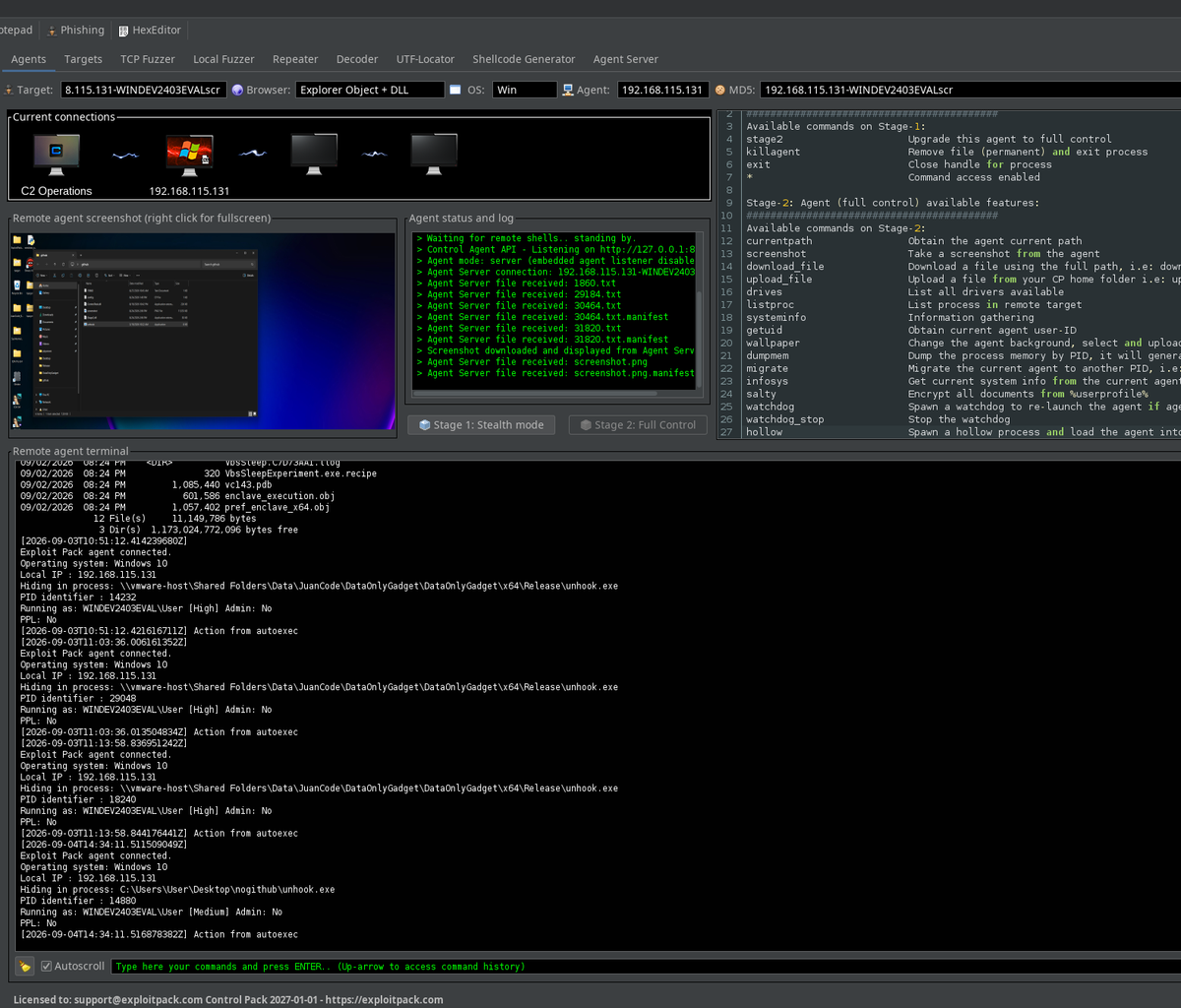
Control Pack is a C2/attack-simulation platform built in Java with a wizard-driven builder and a library of multi-stage agents for adversary emulation, post-exploitation workflows, and red team operators.
Supports agents across Java, .NET, native (Windows), browser, PowerShell, Python, Bash, Perl, and VBS, all sharing an HTTP/HTTPS transport with configurable endpoints/headers/interval/jitter.
Agent setup (precompiled + config), deploy them, get audible alerts on first connection, and manage sessions via a remote terminal and toolbar.
Stage-1 agents provide a minimal shell for stealth.
Stage-2 unlocks richer commands such as host/user discovery, file transfer, screenshots, process/runtime inspection, and advanced Windows-native actions (dump/migrate/hollow/watchdog).
Request a Control Pack quote: Contact us
Key Features
-
Watchdog Function
Injects an independent thread into a legitimate service binary and spawns a companion watchdog process responsible for monitoring the agent’s execution state. If the agent process terminates unexpectedly for any reason, the watchdog automatically relaunches it, while the agent continuously monitors the watchdog and restarts it if needed, enforcing mutual supervision and resilient persistence.
-
Built for Stealth
Built with stealth as a core design principle, its agents rely on native system components, staged execution, in-memory techniques, and controlled communication patterns to blend into normal system and network activity. By minimizing artifacts, avoiding unnecessary processes, and leveraging trusted runtimes, it enables effective operations while reducing exposure to detection and forensic analysis.
-
Stages in Control Pack
Control Pack agents operate in a two-stage model to maintain a structured and low-noise workflow. Stage 1 provides limited interaction focused on validating the environment and establishing a stable connection to the Control Pack server, while Stage 2 unlocks full capabilities such as file transfer, screenshots, memory dumping, encryption of documents and process migration once the agent is upgraded.
-
Java Universal Agent
This agent can run standalone or be injected into a running Java application, allowing it to operate inside a live JVM without restarting or modifying the target. It can discover other Java processes on the system and pivot into them at runtime while providing standard C2 functionalities.
It supports JVM enumeration and runtime attach, enabling in-memory migration between Java processes. -
Windows PE (DLL/PPL)
Runs as a DLL inside a Windows Protected Process Light (PPL), using KNOWNDLL loading to execute from a trusted context instead of launching a separate executable. It includes an Unhooker to remove user-mode API hooks, reducing monitoring and interference, and supports process migration to move execution into other processes while maintaining low visibility.
-
.NET Profiler payload
This agent is implemented as a CLR profiler DLL that is loaded through the .NET profiling mechanism at application startup. Once loaded into a target process, it reads its configuration, connects back to Control Pack, and enables in-process command execution and communication without launching a separate executable, allowing the agent to operate entirely within the context of an existing, trusted application.
-
PowerShell payload
A lightweight script that runs using Windows’ built-in PowerShell and connects back to Control Pack for instructions. It periodically checks in to receive commands, execute them locally, collect information, and send the results back. Because it relies on existing system tools and can be staged, it starts small and can be expanded when needed.
It includes basic environment detection and cleanup functionality, allowing it to remove itself after execution. -
Browser JS Agent
An in-browser implant that runs within the user’s web session and communicates with the C2 server through normal-looking web traffic. It enables tracking and interaction with the browser by collecting contextual data (cookies, page content, plugins, and screen details), capturing user input, executing arbitrary JavaScript, and triggering browser-based actions like alerts or redirects, while blending into legitimate browsing or phishing activity.
-
Bash Payload
Unix-based agent implemented as a shell script runs on Linux and macOS systems. It executes using the native bash environment, establishes communication with Control Pack’s server, and supports remote command execution, system reconnaissance, and file operations by leveraging standard system utilities. Its minimal footprint and reliance on built-in tools allow it to operate without additional dependencies and blend into typical command-line activity.
-
Perl Agent
This agent is an interpreter-based payload for Unix-like systems that executes within the Perl runtime.
It establishes a connection to Control Pack’s server to perform remote command execution, system reconnaissance, and file operations by leveraging native OS utilities, requiring no compilation and minimal dependencies.
-
.NET C# payload
A native Windows payload built in C#, which runs as a standalone executable within the .NET runtime and connects back to Control Pack. It provides C2 capabilities such as command execution, system information collection, and file transfer, operating quietly in the background as a regular Windows process.
-
Python payload
A cross-platform payload for Windows and Linux that establishes a direct TCP control channel to Control Pack’s server. After a simple handshake, it enables remote command execution and returns output, using platform-specific mechanisms such as an interactive shell on Linux and command execution with screen capture on Windows, while maintaining a minimal footprint.
Questions About This Product
What type of license is included?
All our tools are provided under an annual license.
Do licenses renew automatically?
No. Licenses are not automatically renewed. You may choose to renew each year at your own convenience.
How many users can use one license?
Each license is issued on a single-user basis. Sharing between multiple individuals is not permitted.
Integration with other tools
Control Pack agents act as the middle layer: they receive payloads from Exploit Pack and provide a controlled execution environment for follow-on actions. From there, you can optionally escalate capabilities through Kernel Pack for deep-level persistence and complex post-exploit tasks.
Can I use the license against multiple targets?
Yes. While some tools in the industry restrict you to a limited number of targets, our licenses allow you to use the tool against as many machines as needed within your authorised engagements.
Delivery of licenses
Licenses are delivered digitally to the email used at purchase. Since they are sent manually, delivery may take up to 24 hours (usually faster).
Once the order is confirmed and the license has been delivered, it cannot be transferred, and refunds will not be issued.