

The Ultimate Offensive security Platform
Combining our latest research and techniques with expanded capabilities across our 3 tools, plus the power of AI. Ultimate Pack brings exploitation, Command & Control, and kernel-level operations together in a single operational environment for Red Teams, Penetration Testers, and Cybersecurity Professionals.
Built for demanding offensive operations, Ultimate Pack supports the full engagement lifecycle, from initial access and defense evasion to stealth, persistence, and operations against the most complex and fully hardened targets.
Initial access, Command and control and Kernel payloads. They won't see you coming.



Exploit Pack + AI
The most advanced Exploit Framework with a library of 44.000+ public exploits, zero-days and LPE modules, integration with Ghidra, WinDBG, GDB and AI exploit development assistance through the whole workflow.

Control Pack + AI
Avoid detection with a userland C2 built from the ground up for stealth, using our latest research innovations for evasion and hiding techniques, to blind all modern EDR and Antivirus.

Kernel Pack + AI
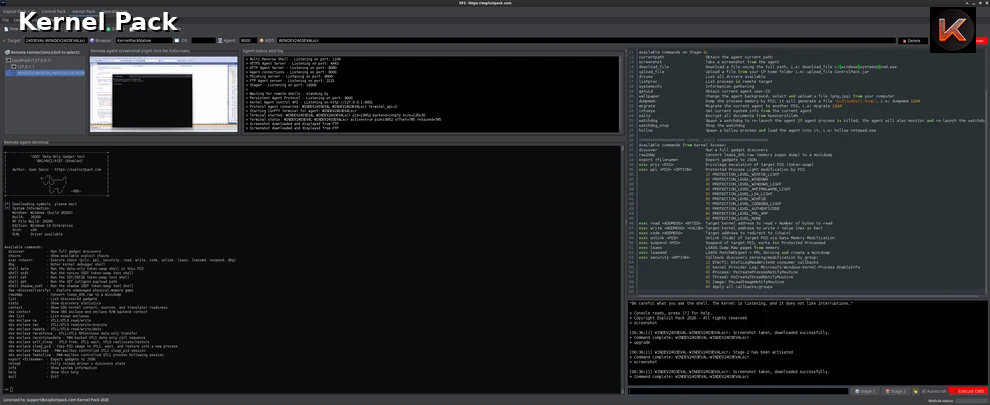
Make Use of more than 100 exploits to take your payload into Kernel space. Construct exploit chains with our in-house-developed DOG (Data-Only Gadgets) attacks and hide even from VBS/HVCI.
From initial access to advanced operations, all in one platform


Built for the way offensive cybersecurity professionals work

Exploit Framework
Full integration with Ghidra, WinDBG and GDB for exploit development with AI assistance. Select from our list of 44.000+ exploits, zero-days or create your own with our exploit templates and obtain that initial access you need for your next penetrationt test.

AI as a Red Team Operator
Use our integrated AI as another operator on your red team. With access to your project, debugger state, and connected agents, it can modify code, operate tools and work alongside your team throughout the whole operation.

Build your own exploits
From crash to shell with an AI operator that connects to Ghidra, WinDbg, and GDB through dedicated APIs and an MCP server, backed by exploit-development tooling and deployable lab agents that turn validated vulnerabilities into working exploits.

Stealth C2 Operations
Customizable Stage 1 and Stage 2 agents, with independent Agent Server, covert GitHub communications, process migration and hollowing, PPL techniques, KnownDLL unhooking, in-memory execution, and VTL1 enclave sleep.

Kernel Payloads
From userland to Kernel with our technique: DOG (Data-Only-Gadgets) to discover usable gadgets and build exploit chains for token and privilege manipulation, callback and ETW control, table hijacking of: SSDT, Shadow SSDT, IDT and GDT, ETW and more.

Operator Log & Reporting
Track exploit execution, agent activity, debugger interaction, tool output, notes, artifacts, and evidence in one operator log. Ultimate Pack keeps the workflow traceable from initial access through C2 and kernel payload operations in one platform.